IPL betting Live markets move faster than almost any other cricket format. Every ball, every wicket, and every toss decision changes the direction of odds. For experienced bettors, this movement is not just entertainment. It creates structured pricing gaps between pre-match toss markets and live match odds that can be used for calculated arbitrage style positioning.
IPL 2026 has made these gaps even more visible due to sharper pre-match modeling and aggressive in-play corrections by bookmakers. Understanding how toss outcomes connect with live match odds is one of the most overlooked edges in modern cricket betting.
Toss betting is usually treated as a standalone market. A team either wins or loses the toss, and most users stop thinking there.
In reality, the toss is the first major pricing event of every IPL match. It directly influences how live odds open and how they adjust in the first few overs.
In IPL betting Live environments, toss results change three key variables:
Once these three factors are processed, live odds immediately react in the first 2 to 4 overs of the match.
For example, in IPL 2026 matches at venues like Wankhede and Chinnaswamy, teams winning the toss and choosing to bowl first often trigger an immediate shift in live match odds toward the chasing side after just one strong powerplay.
Arbitrage between toss markets and live odds is not about finding two different bookmakers with price gaps. In IPL betting, it is about timing mismatch between two stages of pricing:
The gap appears in the short window after the toss when live markets have not yet fully adjusted to pitch and strategy reality.
After the toss is completed, bookmakers adjust match winner odds based on:
However, live odds often do not fully reflect this adjustment until 1 to 2 overs are played.
This creates a short opportunity window where:
In IPL betting Live scenarios, this mismatch is most visible in night games where dew is expected but not yet priced into early live overs.
When a team that wins the toss chooses to bat first and loses early wickets, live odds overcorrect aggressively.
This is because the market assumes:
But in IPL 2026, teams with deep middle order lineups often recover from early collapse situations.
This creates a temporary distortion where:
This mismatch creates a structured pricing imbalance for short duration trades.
The first six overs of IPL matches define the direction of live odds.
But there is a delay between:
For example, a 55 run powerplay at Wankhede is often mispriced initially if wickets fall early. The live market reacts to wickets first and scoring second.
This creates arbitrage behavior between:
Experienced users use this gap to position opposite to emotional market movement.
The toss is not just a binary event. It sets the structure for how live odds behave throughout the innings.
In IPL betting Live analysis, toss decisions impact three live betting phases:
This delayed adjustment cycle is where arbitrage style thinking becomes useful.
True arbitrage in IPL betting Live is not about guaranteed profit. It is about exploiting timing gaps where probability is misaligned between two pricing stages.
A structured approach involves:
This sequence is what separates structured betting from emotional live betting.
Even in IPL 2026, most bettors fail because of timing errors.
Common mistakes include:
Live markets are fast but not perfect. The inefficiency exists in short bursts, not throughout the match.
This season has shown specific patterns that increase live market inefficiencies:
These factors make IPL betting Live markets more reactive, which increases short-term mispricing between toss markets and in-play odds.
Timing is the core factor in any arbitrage style opportunity.
In IPL matches, the usable window is often:
Outside these windows, markets stabilize and pricing becomes efficient again.
At our platform, Fairplay we focus on giving users a structured live betting environment where match movement can be followed in real time without delays in execution. We ensure that users can access live cricket markets quickly, track odds movement clearly, and react to toss outcomes and in-play shifts without disruption.
Our system is designed for users who actively follow IPL betting Live action and want fast updates during every phase of the match. We maintain a stable interface that allows smooth transitions between toss markets and live betting sections so users can respond to market movement without missing timing windows.
IPL In-Play arbitrage between toss markets and live match odds is not about guaranteed profit or simple prediction. It is about understanding how two separate pricing systems interact with each other.
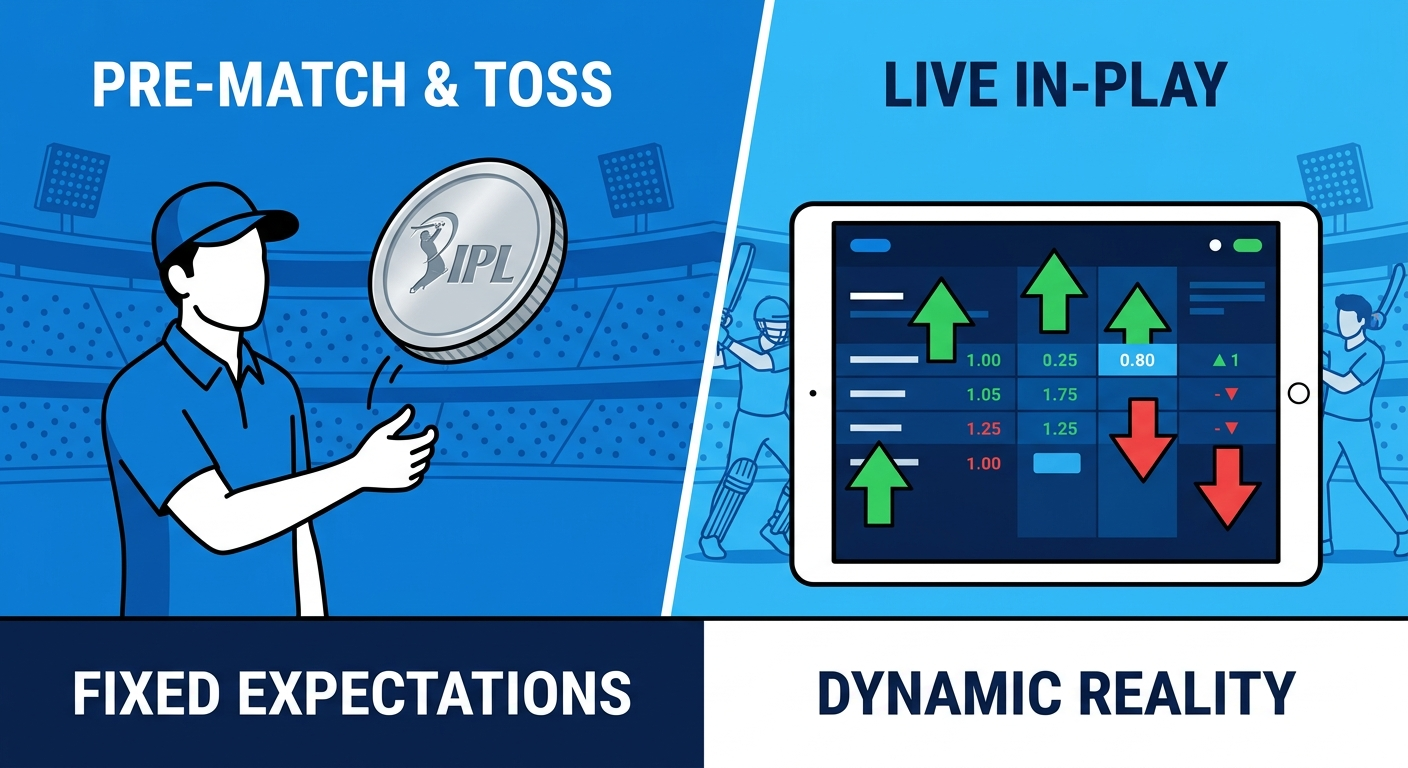
The toss sets expectation, while live betting corrects reality. The gap between expectation and reality is where opportunity exists.
In IPL 2026, this gap is more visible due to faster odds updates and stronger reaction-based pricing models. Bettors who understand timing, match phases, and correction delays can identify structured opportunities within IPL betting Live environments.
Success in this space depends on discipline, timing, and the ability to read how quickly the market corrects itself after each key match event.
IPL in-play arbitrage is a strategy where bettors use timing gaps between toss-based odds and live match odds. The idea is to take advantage of temporary pricing differences that occur when the market has not fully adjusted after the toss or during early overs.
The toss directly affects match expectations such as batting order, pitch behavior, and chasing advantage. However, live odds often take a few overs to fully adjust, creating short windows where pricing may not reflect the actual match situation.
These opportunities usually appear immediately after the toss when live odds have not fully adjusted to match conditions. They also emerge in the first 2 to 4 overs, especially when the market is still reacting to early play. Sudden wickets or fast scoring bursts often create short pricing gaps, and similar opportunities occur during quick momentum shifts in the powerplay when odds lag behind actual match flow.
No, it is not risk-free. Odds can correct quickly, and timing errors can lead to losses. Successful execution depends on fast decision-making, accurate reading of match conditions, and understanding how live markets react to game events.
This approach is best suited for experienced users who actively follow IPL betting Live markets, understand odds movement, track match conditions in real time, and can make quick betting decisions based on live data rather than emotions.